Quick Summary
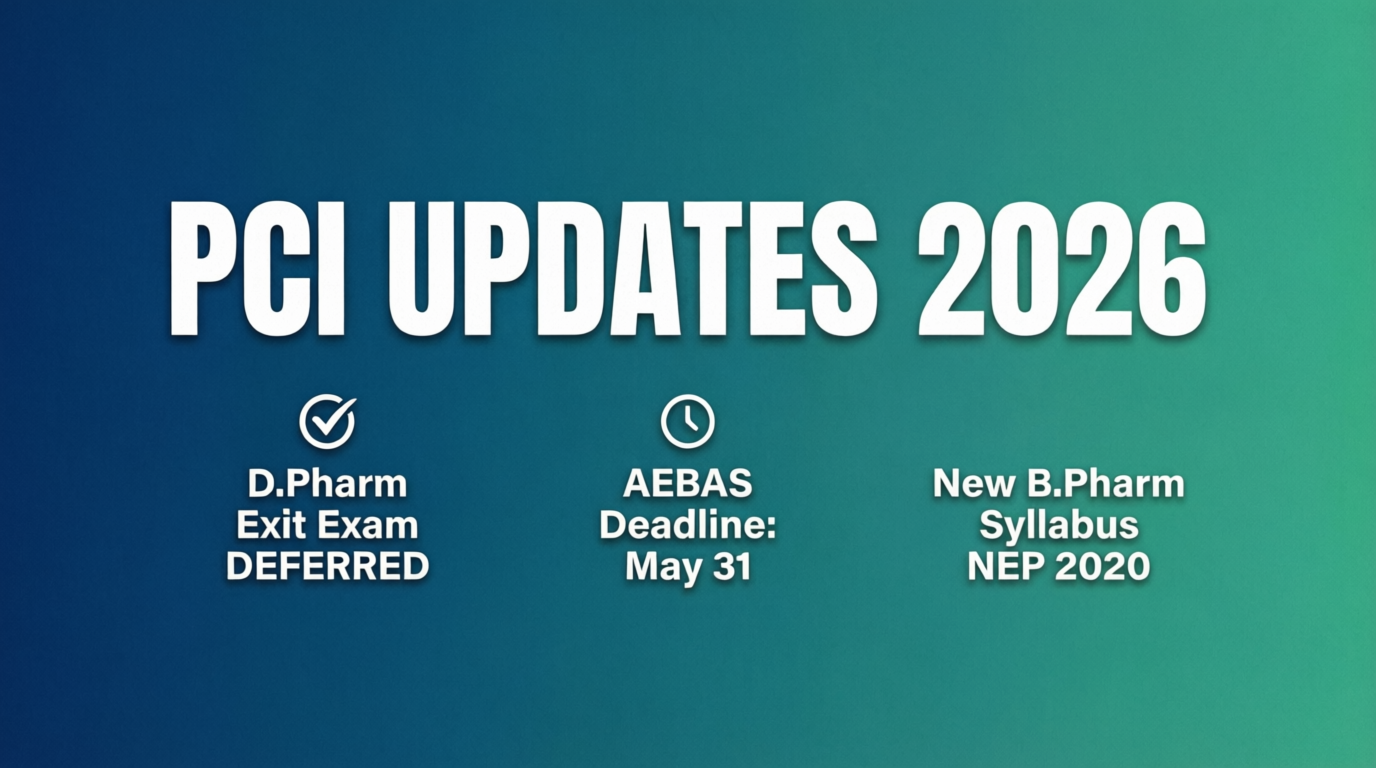
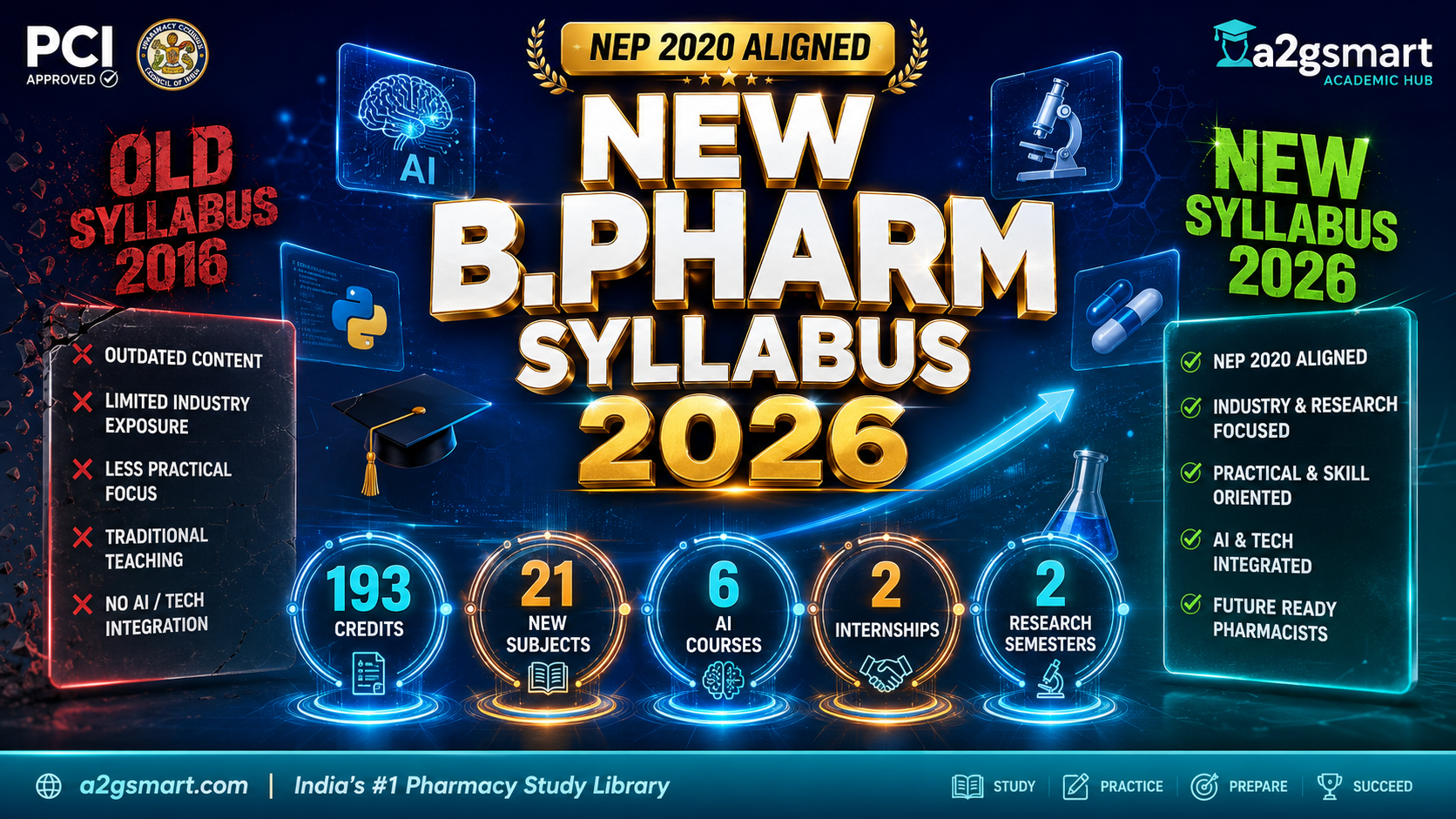
The Pharmacy Council of India (PCI) has officially released the revised B.Pharm syllabus aligned with NEP 2020, effective from the 2026-27 academic session. This is the biggest curriculum overhaul in pharmacy education since 2016.
Key Highlights:
- 193 total credits (up from ~160)
- 21 new subjects added across 8 semesters
- 6 AI & Data Science subjects — Python, Machine Learning, Biostatistics, AI in Pharmacy
- 2 mandatory clinical internships in Semester IV & VI
- 2-semester research project in Semester VII & VIII
- New subjects: Pharmacovigilance, Regulatory Affairs, IPR, Entrepreneurship
For A2G Smart Users: We've updated our B.Pharm Study Materials and GPAT Test Series to align with the new PCI syllabus. Start preparing today!
Table of Contents
- Why Did PCI Change the B.Pharm Syllabus?
- Old vs New Syllabus: Key Differences
- Complete Semester-Wise Subject List (All 21 New Subjects)
- AI & Digital Subjects in B.Pharm: What You Need to Know
- Mandatory Internships: Semester IV & VI
- Research Project: Semesters VII & VIII
- AEC, SEC & VAC Electives Explained
- How the New Syllabus Affects GPAT & NIPER JEE Preparation
- Career Opportunities After the New B.Pharm Syllabus
- Frequently Asked Questions
Why Did PCI Change the B.Pharm Syllabus?
The previous B.Pharm syllabus was implemented in 2016-17. Since then, the pharmaceutical industry has transformed dramatically:
- AI-driven drug discovery is now mainstream
- Data analytics powers clinical trials and pharmacovigilance
- Regulatory affairs demand tech-savvy professionals
- Clinical pharmacy roles are expanding in hospitals
The National Education Policy 2020 mandated multidisciplinary, skill-based education. PCI's new syllabus addresses these gaps by integrating technology, research, and clinical exposure into the B.Pharm curriculum.
Official Reference: PCI Notification No. 14-154/2025-PCI, dated 17 April 2026
Old vs New Syllabus: Key Differences
| Parameter | Old Syllabus (2016) | New Syllabus (2026-27) |
|---|---|---|
| Total Credits | ~160 | 193 |
| AI/Data Science Subjects | None | 6 subjects |
| Python Programming | Not included | Semester I (3 credits) |
| Machine Learning | Not included | Semester III (3 credits) |
| Mandatory Internships | Only after final year | Sem IV + Sem VI (4 credits each) |
| Research Project | Optional/limited | Sem VII + VIII (6 credits each) |
| Pharmacovigilance | Brief module | Standalone subject (Sem VII) |
| Regulatory Affairs | Not separate | Standalone subject (Sem VII) |
| IPR | Not covered | Semester VI (3 credits) |
| Entrepreneurship | Not covered | Innovation & Startup Ecosystem (Sem V) |
| Elective Framework | Limited | Structured AEC + SEC + VAC |
Complete Semester-Wise Subject List
Semester I
| Subject | Type | Credits |
|---|---|---|
| Human Anatomy & Physiology I | Core | 4 |
| Pharmaceutical Analysis I | Core | 4 |
| Pharmaceutics I | Core | 4 |
| Pharmaceutical Inorganic Chemistry | Core | 3 |
| Communication Skills | AEC | 2 |
| Python Programming for Pharmacy | AEC (NEW) | 3 |
| Healthcare Psychology | VAC (NEW) | 2 |
| Remedial Biology/Mathematics | SEC | 2 |
Semester II
| Subject | Type | Credits |
|---|---|---|
| Human Anatomy & Physiology II | Core | 4 |
| Pharmaceutical Organic Chemistry I | Core | 4 |
| Biochemistry | Core | 3 |
| Pathophysiology | Core | 3 |
| Computer Applications in Pharmacy | SEC | 2 |
| Biostatistics & Data Analytics | SEC (NEW) | 3 |
| Environmental Sciences | VAC | 2 |
Semester III
| Subject | Type | Credits |
|---|---|---|
| Pharmaceutical Organic Chemistry II | Core | 4 |
| Physical Pharmaceutics I | Core | 4 |
| Pharmaceutical Microbiology | Core | 4 |
| Pharmaceutical Engineering | Core | 3 |
| Machine Learning for Drug Discovery | AEC (NEW) | 3 |
| Ethics & Human Values | VAC (NEW) | 2 |
Semester IV
| Subject | Type | Credits |
|---|---|---|
| Pharmaceutical Organic Chemistry III | Core | 4 |
| Medicinal Chemistry I | Core | 4 |
| Physical Pharmaceutics II | Core | 4 |
| Pharmacology I | Core | 4 |
| Social Pharmacy & Public Health | SEC (NEW) | 3 |
| Clinical Internship I | Mandatory (NEW) | 4 |
Semester V
| Subject | Type | Credits |
|---|---|---|
| Medicinal Chemistry II | Core | 4 |
| Pharmacology II | Core | 4 |
| Pharmacognosy & Phytochemistry I | Core | 4 |
| Pharmaceutical Jurisprudence | Core | 3 |
| Innovation & Startup Ecosystem | SEC (NEW) | 3 |
| Industrial Pharmacy I | Core | 3 |
Semester VI
| Subject | Type | Credits |
|---|---|---|
| Medicinal Chemistry III | Core | 4 |
| Pharmacology III | Core | 4 |
| Pharmacognosy & Phytochemistry II | Core | 4 |
| Herbal Drug Technology | Core | 3 |
| Intellectual Property Rights (IPR) | SEC (NEW) | 3 |
| AI Applications in Pharmacy | AEC (NEW) | 3 |
| Clinical Internship II | Mandatory (NEW) | 4 |
Semester VII
| Subject | Type | Credits |
|---|---|---|
| Instrumental Methods of Analysis | Core | 4 |
| Industrial Pharmacy II | Core | 4 |
| Pharmacy Practice | Core | 4 |
| Pharmacovigilance & Drug Safety | Core (NEW) | 3 |
| Regulatory Affairs | Core (NEW) | 3 |
| AI in Clinical Applications | AEC (NEW) | 3 |
| Research Project I | Mandatory (NEW) | 6 |
Semester VIII
| Subject | Type | Credits |
|---|---|---|
| Biopharmaceutics & Pharmacokinetics | Core | 4 |
| Pharmaceutical Biotechnology | Core | 4 |
| Quality Assurance | Core | 4 |
| AI Ethics & Translational Applications | AEC (NEW) | 3 |
| Pharmaceutical Management & Marketing Skills | SEC (NEW) | 3 |
| Research Project II | Mandatory (NEW) | 6 |
AI & Digital Subjects in B.Pharm: What You Need to Know
The inclusion of 6 AI and data science subjects is the most talked-about change. Here's what each subject covers:
1. Python Programming (Semester I)
- Data handling with Pandas
- Automating pharmacy workflows
- Building simple analysis scripts
- No prior coding experience required
2. Biostatistics & Data Analytics (Semester II)
- Statistical tests for clinical data
- Data visualization with Python/R
- Real-world clinical trial dataset analysis
3. Machine Learning (Semester III)
- QSAR models for drug discovery
- Drug-target interaction prediction
- Supervised & unsupervised learning
4. AI Applications in Pharmacy (Semester VI)
- AI-driven formulation development
- Drug repurposing with neural networks
- Precision medicine concepts
5. AI in Clinical Applications (Semester VII)
- Clinical decision support systems
- AI-assisted diagnostics
- Electronic health record analytics
6. AI Ethics & Translational Applications (Semester VIII)
- Bias in healthcare AI
- Responsible AI deployment
- Bridging lab research to patient outcomes
💡 Pro Tip: These subjects build progressively. Start strong with Python in Semester I — it forms the foundation for everything that follows.
Mandatory Internships: Semester IV & VI
Unlike the old syllabus where internship was only after final year, the new curriculum introduces two mandatory clinical internships during the programme:
Internship I — Semester IV (4 Credits)
- Focus: Community pharmacy operations
- Activities: Patient counselling, prescription handling, OTC medication guidance
- Setting: Hospital or retail pharmacy under faculty supervision
Internship II — Semester VI (4 Credits)
- Focus: Clinical pharmacy practice
- Activities: Drug information services, ADR reporting, therapeutic drug monitoring
- Assessment: Formal credit-based evaluation
Important: Completion is mandatory for degree conferral. Students cannot skip or defer these components.
Research Project: Semesters VII & VIII
The two-semester research project is another major addition:
| Phase | Semester | Credits | Activities |
|---|---|---|---|
| Research Project I | VII | 6 | Topic selection, literature review, proposal writing, methodology finalization |
| Research Project II | VIII | 6 | Data collection, analysis, thesis writing, viva voce examination |
This mirrors M.Pharm requirements and gives B.Pharm graduates a significant edge when applying for:
- M.Pharm admissions
- Industry R&D positions
- Regulatory roles
AEC, SEC & VAC Electives Explained
Under NEP 2020, electives are categorized into three types:
| Category | Full Form | Focus | Examples from New Syllabus |
|---|---|---|---|
| AEC | Ability Enhancement Courses | Technical competencies | Python, Machine Learning, AI Applications |
| SEC | Skill Enhancement Courses | Practical industry skills | Biostatistics, IPR, Pharmaceutical Management |
| VAC | Value-Added Courses | Ethics & personal development | Healthcare Psychology, Ethics & Human Values |
How the New Syllabus Affects GPAT & NIPER JEE Preparation
For GPAT 2026 Aspirants:
- Pharmaceutical Chemistry (30.5% weightage) and Pharmaceutics (30.5%) remain the highest-scoring areas
- New subjects like Pharmacovigilance and Regulatory Affairs may appear in future GPAT papers
- AI and data analytics concepts could be tested in the "Miscellaneous" section
For NIPER JEE 2026 Aspirants:
- Research project experience will be highly valued in NIPER interviews
- GPAT score remains critical for CSIR/ICMR shortlisting
- AI and ML knowledge gives an edge for NIPER's specialized programs
🎯 Prepare Smarter with A2G Smart: Our AI Study Guide and Master Sheets are updated for the new syllabus. Start your GPAT/NIPER preparation today!
Career Opportunities After the New B.Pharm Syllabus
The new syllabus opens doors to emerging career paths that didn't exist for B.Pharm graduates before:
| Career Path | How New Syllabus Helps | Expected Salary (Entry Level) |
|---|---|---|
| Pharmaceutical Data Analyst | Python, Biostatistics, ML skills | ₹4-6 LPA |
| Clinical Research Associate | Internship experience, research project | ₹3.5-5 LPA |
| Regulatory Affairs Associate | Standalone Regulatory Affairs subject | ₹4-7 LPA |
| Pharmacovigilance Officer | Dedicated Pharmacovigilance subject | ₹3.5-5 LPA |
| Drug Inspector (Govt) | Strong foundation in all core areas | ₹6-8 LPA |
| AI in Drug Discovery | ML, AI Applications subjects | ₹5-8 LPA |
| Pharma Entrepreneur | Innovation & Startup Ecosystem subject | Variable |
| Hospital Pharmacist (Govt) | Clinical internship experience | ₹4-6 LPA |
📌 Related Read: Top 7 Government Jobs After Pharmacy in India (2026)
Frequently Asked Questions (FAQs)
Q1. When does the new B.Pharm syllabus come into effect?
A: The PCI released the revised curriculum in April 2026. Implementation begins from the 2026-27 academic session for new admissions. Existing students continue under the current syllabus.
Q2. How many new subjects are added?
A: 21 new subjects have been added across 8 semesters, including 6 AI/data science subjects, 2 mandatory internships, and 2 research project semesters.
Q3. Is Python Programming compulsory now?
A: Yes. Python Programming for Pharmacy is an AEC in Semester I with 3 credits. It is mandatory, not optional.
Q4. Will the new syllabus help in getting tech jobs?
A: The AI and data science subjects provide foundational skills for pharmaceutical data analysis, clinical informatics, and drug discovery technology — areas with growing demand. While not equivalent to a CS degree, they create a unique pharma + tech skill set.
Q5. What about state university adoption?
A: Universities like RGUHS are expected to adopt the PCI framework within 3-6 months. Students should check their respective university websites for official adoption notifications.
Q6. How should I prepare for GPAT 2026 under the new syllabus?
A: Focus on high-weightage subjects (Pharmaceutical Chemistry & Pharmaceutics — 30.5% each). Use A2G Smart's GPAT Test Series for structured practice.
Q7. Does the new syllabus affect NIPER JEE 2026?
A: The core NIPER JEE syllabus (B.Pharm + M.Sc level + General Aptitude) remains similar, but research project experience and AI knowledge will give you an edge in interviews.
Conclusion
The PCI B.Pharm New Syllabus 2026-27 is a game-changer for pharmacy education in India. By integrating AI, data science, mandatory clinical exposure, and research training, PCI is preparing graduates for the future of healthcare and pharmaceuticals.
Key Takeaways:
- ✅ 193 credits, 21 new subjects
- ✅ 6 AI subjects from Semester I to VIII
- ✅ 2 mandatory internships + 2-semester research project
- ✅ New career paths in pharma tech, data analytics, and regulatory affairs
🚀 Start Preparing Today: A2G Smart has updated all study materials, test series, and AI study guides to align with the new PCI syllabus. Explore our resources and stay ahead of the curve!
About A2G Smart
A2G Smart is India's #1 pharmacy study library, trusted by thousands of B.Pharm students for GPAT, NIPER JEE, and government exam preparation. Our platform offers Master Sheets, AI-powered Study Guides, Test Series, and expert career guidance.
Stay Updated: Follow our Academic Blog for the latest pharmacy news, exam strategies, and career guidance.
Last Updated: July 2026