
🌱 PLANT TISSUE CULTURE — Definition & Concept
🕰 HISTORICAL DEVELOPMENT

HISTORICAL MILESTONES
| Year | Scientist | Development |
|---|---|---|
| 1902 | Haberlandt | Proposed PTC concept |
| 1904 | Hannig | Embryo culture established |
| 1909 | Kuster | Observed cell fusion |
| 1922 | Robbins & Kotte | In-vivo root tip cultivation |
| 1934 | White | First permanent root culture |
| 1934 | Gautheret | First permanent callus culture |
| 1942 | Gautheret | Observed secondary metabolites |
| 1953 | Muir | Developed single cell culture |
| 1955 | Mothes & Kala | First secondary metabolite report |
🌿 PLANT TISSUE CULTURE INITIATION — Process Flow
- Explant selection
- Surface sterilization
- Culture initiation
- Multiplication
- Rooting
- Shooting
- Hardening
🧫 TYPES OF CULTURES
| Growth Type | Characteristic | Examples |
|---|---|---|
| Determinate Growth | Fixed shape/size | Leaves, Flowers |
| Indeterminate Growth | Continuous growth | Roots, Stems |
🌾 SEED CULTURE
Key Principle: Obtain sterile explants and seedlings.
| Aspect | Benefit / Application |
|---|---|
| Germination | Bypasses asymbiotic germination |
| Orchids | Crucial for orchid production |
| Efficiency | Increases germination efficiency |
🌱 EMBRYO CULTURE
Key Principle: Rescue immature embryos or overcome dormancy.
| Aspect | Benefit / Application |
|---|---|
| Ploidy | Produces haploids |
| Dormancy | Prevents seed dormancy |
| Breeding | Shortens breeding cycles |
| Development | Prevents embryo abortion |
| Fruits | Useful for early ripening fruits |
🌿 MERISTEM CULTURE

Key Principle: Produce virus-free plants due to tip a-vascularity.
| Aspect | Benefit / Application |
|---|---|
| Success | Successful in herbaceous plants (e.g., Potato, banana) |
| Disease Control | Enables virus-free plant production |
| Conservation | Facilitates germplasm conservation |
| Genetic Eng. | Used for transgenic plant production |
PROCESS
- Shoot tip selection
- Surface sterilization
- Distilled water wash
- Transfer to MS medium
- Incubation (≈25°C, light)
- Root & shoot development
- Transfer to pots (hardening)
🌿 BUD CULTURE
Key Principle: High cytokinin medium to stimulate shoot proliferation.
| Aspect | Benefit / Application |
|---|---|
| Method | Simple micropropagation method |
| Health | Yields disease-free plants |
| Extraction | Easier isolation of phytoconstituents |
🟩 CALLUS CULTURE
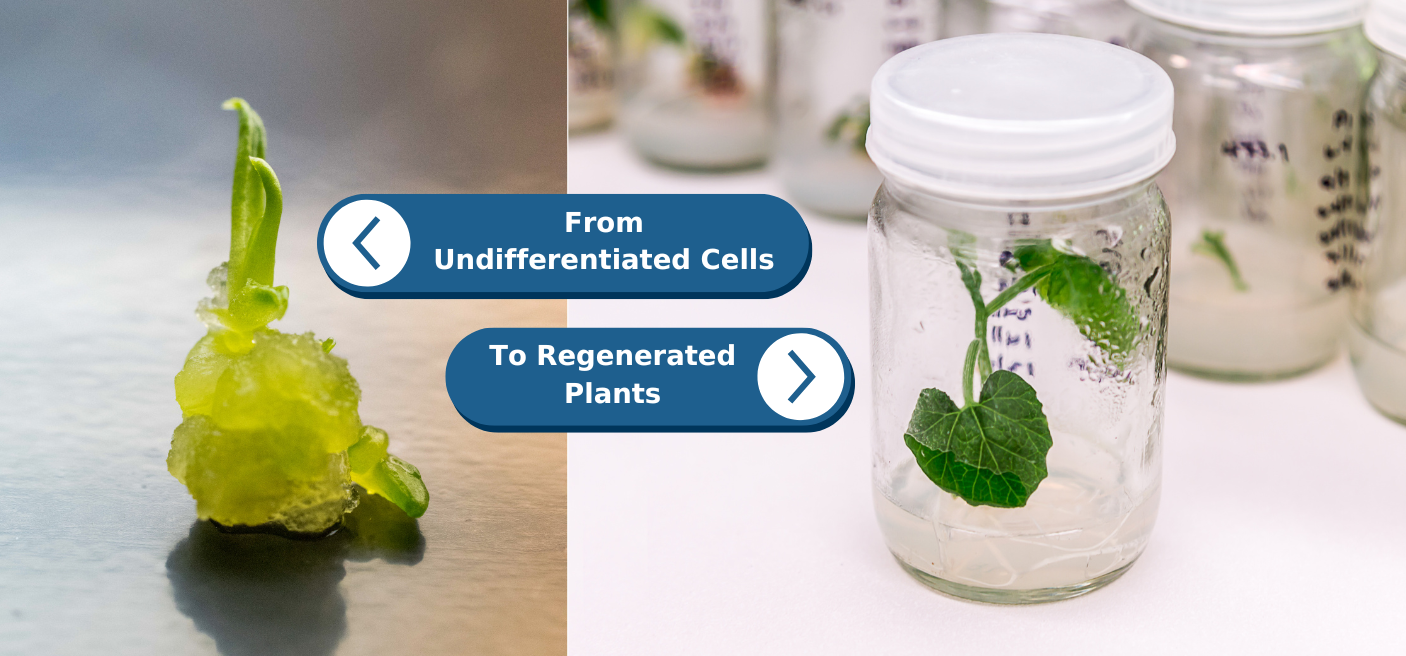
Key Principle: Grown on agar medium, often with balanced hormones.
| Aspect | Benefit / Application |
|---|---|
| Genetics | Allows for chromosomal variation studies |
| Metabolites | Used for secondary metabolite extraction |
| Source | Serves as a source for suspension culture |
| Research | Applied in biochemical assays |
🧪 CELL SUSPENSION CULTURE
Key Principle: Promotes rapid cell division and uniform growth.
| Aspect | Benefit / Application |
|---|---|
| Research | Studies physiology & metabolism |
| Process | Performs biotransformation |
| Biotech | Used in genetic engineering |
| Development | Induces somatic embryos & shoots |
| Toxicity | Avoids toxic product accumulation |
🌼 ANTHER / POLLEN CULTURE
Key Principle: Produces haploid plantlets from gametes.
| Aspect | Benefit / Application |
|---|---|
| Mutation | Facilitates mutation studies |
| Ploidy | Produces double haploids |
| Genetics | Enables genetic recombination studies |
| Development | Used for differentiation studies |
🧬 PROTOPLAST CULTURE
Key Principle: Allows fusion for novel hybrids and regeneration.
| Aspect | Detail / Application |
|---|---|
| Methods | Enzymatic or Mechanical |
| Morphogenesis | Studies morphogenesis |
| Photosynthesis | Analyzes photosynthesis |
| Regeneration | Regenerates whole plants |
| Hybridization | Forms novel hybrids via fusion |
🌱 HAIRY ROOT CULTURE


Key Principle: High growth rate and secondary metabolite production without hormones.
| Aspect | Characteristic / Benefit |
|---|---|
| Metabolites | High secondary metabolite yield |
| Growth | Exhibits hormone-free growth |
| Rate | Characterized by fast growth |
| Genetics | Useful for gene function analysis |
| Regeneration | Enables whole plant regeneration |
🧫 IMMOBILIZED CELL CULTURE
Key Principle: Enhances cell stability and product recovery.
| Aspect | Benefit / Application |
|---|---|
| Biotransformation | Facilitates biotransformation |
| Protection | Protects cells in fermenters |
| Technology | Used in synthetic seed technology |
| Transfer | Aids protoplast transfer |
| Culture Longevity | Supports long-term single cell culture |
🧪 NUTRITIONAL REQUIREMENTS IN PLANT TISSUE CULTURE
| Nutrient Type | Requirement | Examples |
|---|---|---|
| MACRONUTRIENTS | Elements required at > 0.5 mmol/L | Nitrogen (N), Phosphorus (P), Potassium (K), Calcium (Ca), Magnesium (Mg), Sulfur (S) |
| MICRONUTRIENTS | Required in trace amounts | Iron (Fe), Manganese (Mn), Zinc (Zn), Boron (B), Copper (Cu), Molybdenum (Mo), Cobalt (Co) |
| CARBON SOURCE | Supplies energy & carbon skeletons (cultures are heterotrophic) | Sucrose (most common), Glucose, Maltose |
| VITAMINS | Act as coenzymes to support cell division and growth | Thiamine (B1), Pyridoxine (B6), Nicotinic acid (B3), Myo-inositol |
| HORMONES (GROWTH REGULATORS) | Influence growth and differentiation | (e.g., auxins, cytokinins) |
| ADDITIVES | Special components for specific needs | Natural: Coconut milk, Yeast extract; Solidifying Agents: Agar, Alginate; Special Additions: EDTA, Activated charcoal, Antibiotics |
🌿 GROWTH REGULATORS IN TISSUE CULTURE MEDIA

Plant hormones are key for tissue growth and differentiation.
| Regulator | Examples | Functions |
|---|---|---|
| AUXINS | IAA, IBA, NAA, 2,4-D | Root formation, Callus induction, Cell elongation |
| CYTOKININS | Kinetin, BAP, Zeatin | Shoot initiation, Bud formation, Cell division |
| GIBBERELLINS | GA₃ | Stem elongation, Breaking dormancy |
HORMONE BALANCE CONCEPT
| Auxin : Cytokinin Ratio | Resulting Growth |
|---|---|
| High Auxin / Low Cytokinin | Roots |
| Low Auxin / High Cytokinin | Shoots |
| Intermediate Ratio | Callus |
⚙️ APPLICATIONS OF PLANT TISSUE CULTURE IN PHARMACOGNOSY
| Category | Specific Applications |
|---|---|
| PROPAGATION | Micropropagation of medicinal plants; Somatic embryogenesis; Synthetic seed production; Biomass energy for forestry |
| BREEDING & CONSERVATION | Haploid plant production; Germplasm conservation; Rapid homozygous line development |
| METABOLITE PRODUCTION | Secondary metabolite extraction; Biotransformation studies |
| TRANSGENIC PLANTS | Development of GMOs with enhanced traits; Improved insect/herbicide resistance; Better nutritional quality (e.g., golden rice) |
💉 EDIBLE VACCINES (PLANT-BASED VACCINES)
| Aspect | Details / Examples |
|---|---|
| PLANT EXAMPLES | Tobacco, Potato, Banana, Tomato, Rice, Carrot, Corn, Soybean |
| KEY LIMITATION | Must be eaten raw (cooking denatures antigens) |
| FIRST HUMAN TRIAL (1997) | Transgenic potato expressed E. coli toxin B-subunit; Tested for diarrhea immunity |
| ADVANTAGES | Needle-free, Low cost, No cold chain, Easy storage, Oral administration, Suitable for developing regions |
| IMPORTANCE & USES | Cancer therapy research (colon, cervical); Combats infectious and autoimmune diseases; Potential for mass immunization |
Upgrade to Success Pass (₹30) to unlock downloads and printing.